1. From Conversation to Direct Computer Use
For years, interacting with AI meant copying code snippets, parsing text, or manually moving data between tools. Astra changes that paradigm by introducing native desktop and browser navigation.
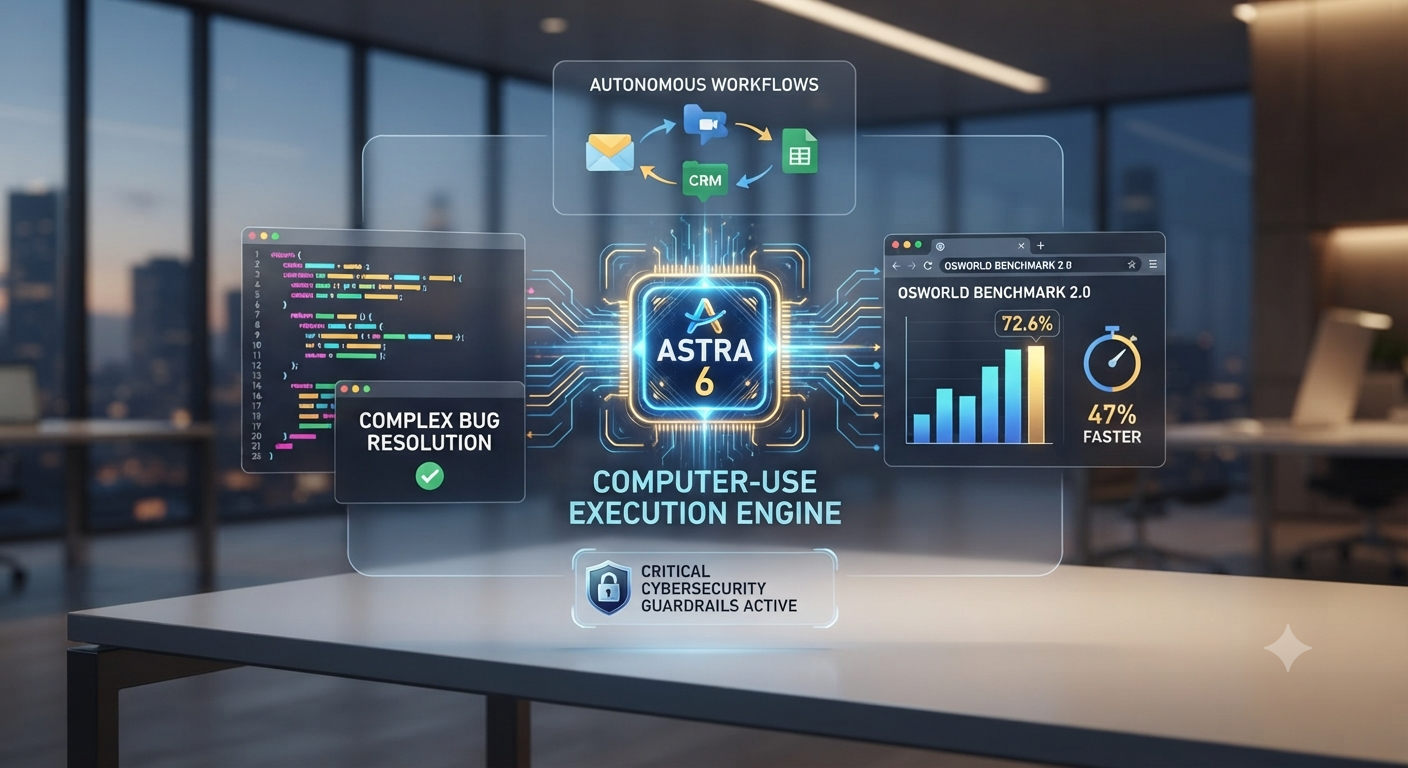
Autonomous Workflows: Astra can take an open-ended goal—such as filling out intricate tax forms, updating enterprise CRM records, or orchestrating calendar management—and carry it out across software interfaces without a dedicated API.
Unmatched Efficiency: According to benchmark testing on OSWorld 2.0 (which measures desktop environment operation), Astra scored 72.6% while completing tasks nearly 47% faster per task than its predecessor, GPT-5.6 Sol.
Intelligent Error Recovery: Rather than stalling when hitting a snag mid-workflow, Astra can react to on-screen errors, evaluate alternate choices, ask clarifying questions if information is missing, or make safe routine assumptions to keep projects moving forward.
2. Software Engineering and Advanced Coding Capabilities
For developers and software teams, Astra represents a massive leap forward in automated development and debugging.
Complex Bug Resolution: The model can independently reproduce complicated bugs, investigate underlying root causes, write proposed fixes, and prepare code modifications ready for developer code-review.
Context Retention: Addressing a long-standing pain point in software engineering sessions, Astra retains notes across context windows and can search earlier session data rather than relying strictly on compressed conversational summaries.
Superior Efficiency: Industry evaluations show that despite commanding a higher per-token price, Astra often achieves lower overall task costs because it solves complex coding benchmarks using a fraction of the total tokens required by earlier generations.
3. Cybersecurity Milestones and Guardrails
With great capability comes heightened risk, prompting OpenAI to implement strict safety protocols around Astra's rollout.
"Critical" Preparedness Classification: Astra crossed the threshold into OpenAI's "Critical" cybersecurity risk category during testing, having discovered and utilized multiple zero-day vulnerabilities in sandboxed environments.
Controlled Access: Due to its advanced code-execution and exploit capabilities, OpenAI has placed strict guardrails around the model, rolling out its full suite of features selectively to trusted enterprise partners, developers via AWS and Microsoft Foundry, and ChatGPT subscription tiers.
What This Means for the Future of Work
GPT-6 Astra signals that the value of an AI model is no longer tied solely to how fast it can generate a paragraph of text, but how autonomously it can shoulder complex operational burdens. Whether it is building fully functional web applications from a single prompt, managing enterprise business intelligence dashboards, or executing multi-step scientific simulations, the boundary between assistant and active digital coworker has officially blurred.