How AI Is Changing Everyday Life
AI is already present in many of the tools and services people use every day.
Search engines use AI to understand what users are looking for. Streaming platforms recommend movies and music based on viewing and listening habits. Smartphones use AI for voice assistants, photography improvements, translation, and security features.
Even applications that do not appear to be "AI-powered" may use machine learning behind the scenes to automate processes, detect unusual activity, or personalize the user experience.
The Positive Impact of AI
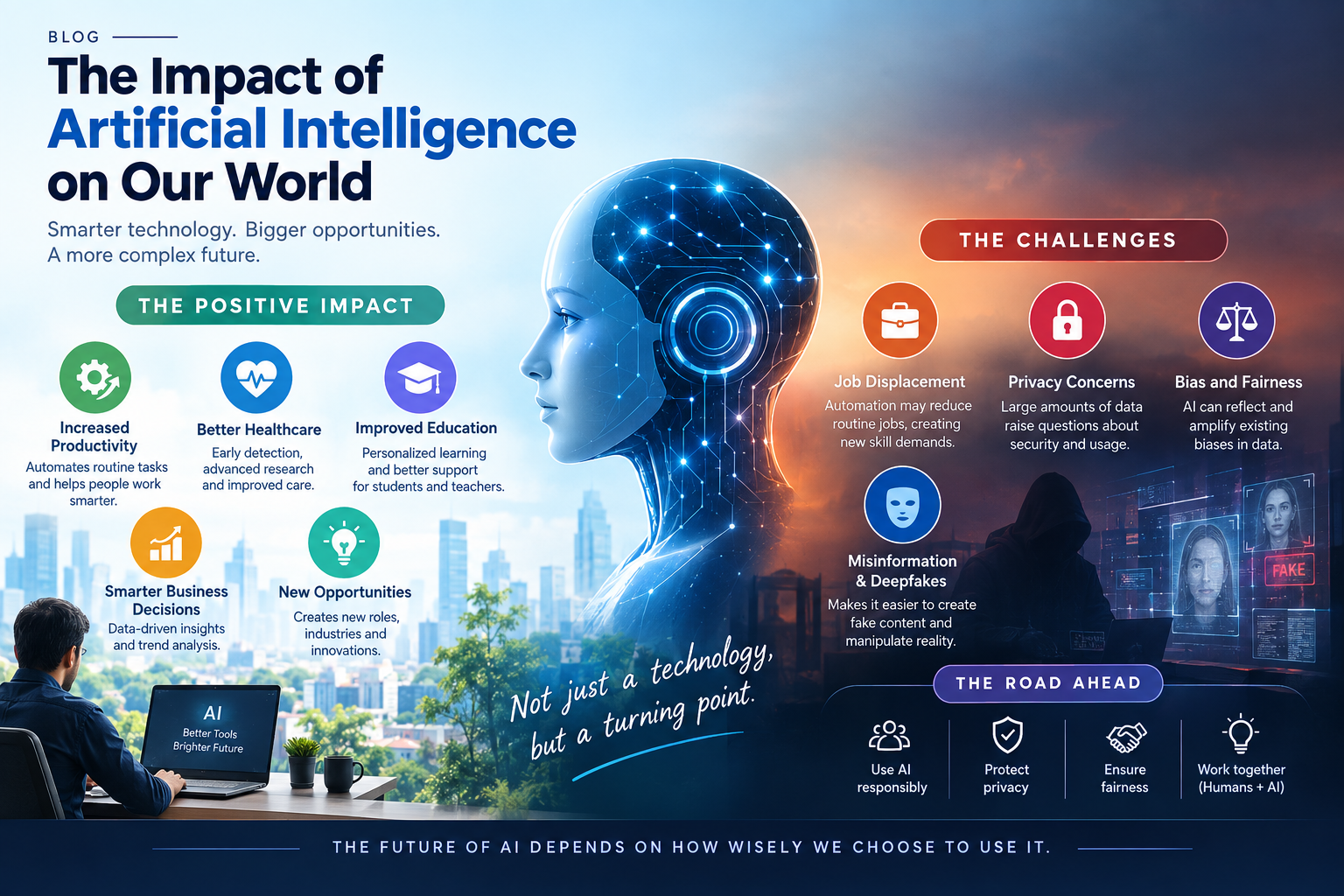
1. Increased Productivity
One of the biggest advantages of AI is its ability to automate repetitive tasks.
Businesses can use AI to analyze documents, generate reports, organize information, answer common customer questions, and assist employees with routine activities. This allows people to spend more time on creative thinking, problem-solving, and strategic work.
AI does not necessarily replace every human task. In many situations, it acts as a tool that helps people complete their work faster and more efficiently.
2. Transforming Healthcare
AI has significant potential in healthcare. Intelligent systems can assist doctors in analyzing medical images, identifying patterns in patient data, and supporting clinical decision-making.
AI can also help researchers analyze large datasets during drug discovery and medical research. When used responsibly alongside qualified healthcare professionals, these technologies can improve efficiency and potentially contribute to earlier detection of certain conditions.
3. Improving Education
AI is also changing how people learn.
AI-powered learning platforms can provide personalized explanations, practice questions, feedback, and learning recommendations. Students can use AI tools to understand difficult concepts, while teachers can use them to support lesson planning and administrative work.
However, AI should support learning rather than replace the learning process itself. Developing independent thinking and problem-solving skills remains essential.
4. Helping Businesses Make Better Decisions
Organizations generate enormous amounts of data. AI can analyze this information and identify trends that may be difficult to discover manually.
Businesses can use AI for demand forecasting, customer analysis, fraud detection, inventory management, marketing, and operational planning.
This can help organizations make faster and more informed decisions.
5. Creating New Opportunities
Although AI may automate some existing tasks, it is also creating new roles and industries.
Demand is growing for professionals working in areas such as AI engineering, data science, machine learning, cybersecurity, AI product development, and AI governance.
The workforce of the future will increasingly require people who understand how to work with AI rather than simply compete against it.
The Negative Impact of AI
AI also introduces challenges that cannot be ignored.
1. Job Displacement
Automation can reduce the need for humans to perform certain repetitive tasks. Jobs involving highly predictable and routine activities may be particularly affected.
At the same time, technology has historically created new types of work. The challenge is ensuring that workers have opportunities to develop the skills needed for changing job markets.
Continuous learning and reskilling will therefore become increasingly important.
2. Privacy Concerns
Many AI systems depend on large amounts of data. This creates concerns about how personal information is collected, stored, analyzed, and used.
Organizations must implement strong security practices and clear data policies to protect users and maintain trust.
3. Bias and Fairness
AI systems learn from data. If the data contains biases, an AI system may reproduce or even amplify those biases.
This can become particularly concerning when AI is used for areas such as recruitment, lending, education, insurance, or other decisions that affect people's lives.
Developers and organizations must therefore evaluate AI systems for fairness and ensure that important decisions are not blindly delegated to automated systems.
4. Misinformation and Deepfakes
AI has made it easier to create realistic text, images, audio, and videos.
While these technologies have legitimate creative and educational applications, they can also be misused to create misinformation, impersonation, scams, and manipulated media.
As AI-generated content becomes harder to distinguish from human-created content, digital literacy and reliable verification methods will become increasingly important.
AI and the Future of Work
The future of work is unlikely to be simply "humans versus AI."
A more realistic future is likely to involve humans working alongside AI systems.
AI can handle repetitive analysis, generate ideas, summarize information, and automate routine workflows. Humans remain important for creativity, empathy, leadership, judgment, communication, and understanding complex real-world situations.
The most valuable skill may therefore not be knowing everything about AI, but knowing how to use AI effectively and responsibly.
The Importance of Responsible AI
As AI becomes more powerful, responsible development becomes increasingly important.
Companies and developers should consider:
- Data privacy
- Security
- Transparency
- Fairness
- Human oversight
- Accountability
- Ethical use of AI
- Protection against misuse
AI should be designed to solve real problems while minimizing potential harm.
Technology itself is neither completely good nor completely bad. Its impact depends largely on how people design, deploy, regulate, and use it.
How Individuals Can Prepare for an AI-Driven Future
People do not necessarily need to become AI researchers to benefit from AI.
Some useful steps include:
- Learn the basics of AI and machine learning.
- Understand how AI tools work and their limitations.
- Develop strong problem-solving and analytical skills.
- Improve communication and creative skills.
- Learn how to verify AI-generated information.
- Use AI as a productivity tool rather than depending on it completely.
- Continue learning as technology evolves.
The ability to adapt may become one of the most valuable skills in an AI-driven economy.
Conclusion
Artificial Intelligence is transforming almost every major area of modern society. It can increase productivity, improve healthcare, personalize education, support businesses, and create new opportunities.
At the same time, AI introduces serious challenges involving employment, privacy, bias, misinformation, and security.
The goal should not be to stop technological progress, but to make sure that progress is responsible and beneficial to society.
The future of AI will ultimately depend not only on how intelligent our machines become, but on how wisely humans choose to use them.